Showing posts sorted by relevance for query blues piano. Sort by date Show all posts

Monday, March 24, 2008

Blues Piano - Day 1 - Some examples

OK, to keep this interesting I want to cover blues Piano this week. I am partial to the harmonica because I paly that instrument, but I envy piano players becasue in my mind they have real skills. Not that us harmonica players do not, but the piano has so much more to offer and the best piano blues players are real showmen.

According to Piano Blues@About.com

The piano has earned an honored place in the history of the Blues. Though not as popular or convenient as a guitar or harmonica, the piano has carved out a deep tradition in America's music. Why the piano? Why not the trumpet, violin, tuba, or other traditional musical instruments that were available throughout the evolution of the Blues. Let's take a look at history of Blues piano.
A great point made in this article is "W.C. Handy made his name as the "Father of the Blues" by transcribing Blues music for the world to then learn." Facts like this help us to really understand what the blues have become over the years. That is why I want to explore each instrument one by one.

This article also covers the various blues piano styles. Please click links to see a YouTube video of the give style.

Ragtime - Scott Joplin - Stoptime Rag

Stride - Jelly Roll Morton - Hesitation Blues

Boogie Woogie - Albert Ammons - swanee river boogie

Chicago Style - Otis Spann - T'Aint Nobody's Business If I Do

West Coast - Merry Christmas Baby - Charles Brown blues

New Orleans - Make This World A Better Place


Tuesday, March 25, 2008

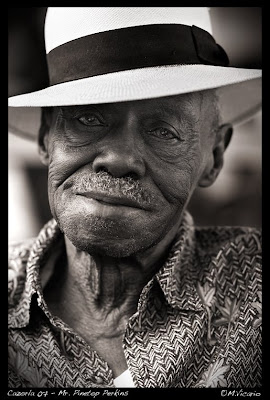
Blues Piano Day 2 - Pinetop Perkins

Pinetop Perkins
Photo by Manuel Vicari


Can't really have a blues piano week if you don't have some Pinetop Perkins, now can you? I think the bio on his official website says it all;

Pinetop Perkins is one of the last great Mississippi bluesmen still performing. He began playing blues around 1927 and is widely regarded as one of the best blues pianists. He’s created a style of playing that has influenced three generations of piano players and will continue to be the yardstick by which great blues pianists are measured.

I like the video below, because it it shows where Mr. Perkins is in his life. I really like the end where he says, "Well I'm trying to make it, 93 years young and I'm still trying to make it." Now that is the blues, I hope I'm still trying to make it in my ninities. Mr. Perkins will be 95 this comming July 7th, God willing.


Notes from YouTube; Pinetop Perkins and Anthony Sapienza perform Pinetop's hit "Kansas City" the day after Pinetop's gig at B.B. King's Blues Club in NYC. November 2006. Pinetop will be featured in a cover story in the December 2006 issue of Seventh Hour Blues, available at www.seventhhourblues.com

Mr. Perkins is an award winning blues piano player;

In 2005 he was also presented with a lifetime achievement award at the Grammy’s. In 2000 he received a National Heritage Fellowship from the National Endowment of the Arts. He has been featured in the documentary Piano Blues directed by Clint Eastwood for the Martin Scorsese PBS series, The Blues. In addition, he continued to win the Blues Music Award for best blues piano every year until 2003 when he was retired from that award, which now bears his name--the Pinetop Perkins Piano Player of the Year.

References;

Pinetop Perkins Official Web Site

Pintop Perkins @ MySpace

Pintop Perkins @ Wikipedia


Tuesday, April 01, 2008

Blues Piano Day 7 - Champion Jack Dupree

I was going to post a video of Bukka White playing some Boogie Woogie, because I think it is such a cool video.

Then I thought about posting this blues piano video (1), this one (2), this one(3), this one (4) and this one (5). And if you watch them all I am sure you will enjoy them.

But then I came across a video of a bluesman, whose music I truly love. It's funny to me that I did not think of Champion Jack Dupree when I thought of doing a week of post on the blues piano.

I guess it is true what they say about your memory being the second thing to go.

Champion Jack Dupree with King Curtis


Champion Jack Dupree


I like Mr. Dupree so much because he was a true man of Louisiana (and a man of the world too), his speech, his diction, his style, his rhythm and of course his musical skills all spring from his youth in Louisiana. And that may be why I did not think of of him at first. I have included too many bluesmen from Louisiana in my list of blues piano players I fear, but what can I say. It was not only Mr. Dupree's piano playing that attracted me to his music. I really like how he sings and talks. He had a way with words. Consider these quotations;

  • "When you open up a piano, you see freedom. Nobody can play the white keys and don't play the black keys. You got to mix all these keys together to make harmony. And that's what the whole world needs: Harmony."

  • "Nasty Boogie Woogie" by Jack Dupree
    Mama bought a chicken, she took him for a duck
    Laid him on the table with his legs stuck up
    Yonder come the children with a spoon and a glass
    Catch the gravy droppin' from his yes, yes, yes

  • "Death of Martin Luther King", recorded just after his assassination
    I know you people, I know you glad you ain't one of me
    I know you people glad, I know you glad you white and free
    Oh yeah, white and free, oh, what will, what will become of me?
    Oh I am begging, yes, I'm begging to be free.

Champion Jack Dupree mp3 posted @ This Recording Blog
The Life I Lead - the mp3 file is down the page.

reference;

Champion Jack Dupree @ Wikipedia

Illustrated Champion Jack Dupree discography

Wikipedia's List of Piano blues musicians

Champion Jack Dupree search @ YouTube


Thursday, August 14, 2008

Boogie-Woogie

Boogie-Woogie is also one of my favorite forms of the blues. According to Wikipedia;

Boogie-woogie is a style of piano-based blues that became very popular in the late 1930s and early 1940s, but originated much earlier, and was extended from piano, to three pianos at once, guitar, big band, and country and western music, and even gospel. Whilst the blues traditionally depicts sadness and sorrow, boogie-woogie is associated with dancing. The lyrics of one of the very earliest, "Pinetop's Boogie Woogie", consist entirely of instructions to dancers:
Now, when I tell you to hold it, I don't want you to move a thing. And when I tell you to get it, I want you to Boogie Woogie!
It is characterized by a regular bass figure, an ostinato and the most familiar example of shifts of level, in the left hand which elaborates on each chord, and trills and decorations from the right hand.

The origin of the term boogie-woogie is unknown, according to Webster's Third New International Dictionary. The Oxford English Dictionary states that the word is a redoubling of boogie, which was used for rent parties as early as 1913. The term is often hyphenated. Blues historian Robert Palmer wrote that the boogie-woogie style bass pattern may have been created in the logging and turpentine camps and oil boomtowns of Texas, Louisiana, and the Mississippi Delta circa 1900. Palmer also reports that Willie Dixon told Karl Gert zur Heide, author of "Deep South Piano" that in Mississippi before the term boogie was used, the eight to the bar piano patterns were called "Dudlow Joes".

In an interview with NPR blues singer and pianist Marcia Ball stated that "Boogie woogie started out with a bunch of different names, depending on where you were. Apparently there was a song by a guy named Dudlow, Joe Dudlow. He’s the first guy that a lot of them heard that was playing that kind of um… [playing]. And so they called it that for a while, Dudlow Joe." The precise origin of boogie-woogie piano is, however, uncertain; it was no doubt influenced by early rough music played in honky tonks in the Southern United States. W.C. Handy and Jelly Roll Morton both mentioned hearing pianists playing this style before 1910. According to Clarence Williams, the style was started by Texas pianist George W. Thomas. Thomas published one of the earliest pieces of sheet music with the boogie-woogie bassline, "New Orleans Hop Scop Blues" in 1916, although Williams recalled hearing him play the number before 1911. The term "boogie" itself was in use very early, as in Wilbur Sweatman's "Boogie Rag" recorded in April, 1917. link


For more info click blues piano @ SqueezeMyLemon.

List of Boogie Woogie Musicians @ Wikipedia.


Monday, June 29, 2009

Dave Perkins - Pistol City Holiness

I just received a copy of Dave Perkins latest CD Pistol City Holiness, and overall I really like it. This CD will be getting heavy rotation in my CD player for sure.

Dave Perkins is one of those musicians who has "crisscrossed the map of American music." And it shows, this CD is well crafted and the presentation shows a deep understanding, respect and love of playing, esp playing blues music.

The overall sound of the CD is very bluesy, that is propelled by a big bad harmonica, some smoking boogie woogie piano playing, whaling electric guitars and very good singing. Perkins lyrics are steeped in the blues, but fresh as he delivers them with confidence and style. There is no doubt that Mr. Perkins is a student of Muddy Waters and Howlin' Wolf.

I really enjoy how many of the themes of blues, folk, gospel, and rock music are blended here to make a coherent whole. Which again speaks to how good the lyrics and the delivery are here.

With Pistol City Holiness, Perkins comes full circle to his first love—the blues. “The blues was the first music to capture my imagination,” says Perkins. “It grabbed me because it was something other—alien—and, yet, at the same time, deeply familiar. I’ve never gotten over it. I’ve worked in a lot of different styles of music, but my approach to each one was and will always be shaped by the blues.”
I really enjoy the harmonica playing of TJ Klay, and the piano and organ playing of Reese Wynans on this CD. As a matter of a fact that is what stands out about this CD, the playing is top level. And Dave Perkins' singing and electric guitar make this a pile of red hot smoking blues rock. Just the way you like it.

Track Listing for Pistol City Holiness

1. Break (starts and ends with some blistering Harmonica)
2. Going Down (singing and guitar playing)
3. Cherryfish & Chicken (nice harp and organ work)
4. Reveval (nice gospel themed blues rock here)
5. Long Eleven Road (love the interplay of harp and guitars)
6. Bottles and Knives (barrel house at its best, great piano)
7. Train at Night (foot tapping blues song, reminds me of Muddy)
8. Flown (one of those sad heart ache blues songs)
9. Tiger Texas (good Texas blues rock, lyrics)
10 Devil's Game (sweet little blues song, cool acoustic guitar)
11. Preacher Blues (great lyrics, more religion and spirituality)
12. Mercy in the Morning (great singing, harmonica and organ playing here)


DAVE PERKINS: Pistol City Holiness
Buy the CD @CD Baby


Pistol City Holiness @Amazon.com

Dave Perkins @MySpace


Saturday, March 29, 2008

Blues Piano Day 5 - Professor Longhair

Professor Longhair is another Louisiana raised blues piano man. They called him the professor because he was not only a wizard of the keyboard but influenced many of those who have come after him.

The Rock and Roll Hall of fame says;

Henry Roeland “Roy” Byrd - better known to the world as Professor Longhair or “Fess,” for short - stands as the foremost exponent of New Orleans piano style. Byrd’s idiosyncratic style is a rhythmic jambalaya reflecting the freewheeling, good-time spirit of the Crescent City. Professor Longhair soaked up influences from close-at-hand sources - barrelhouse boogie-woogie, Caribbean rhythms like the rumba (many of his relatives were West Indian), and the Crescent City’s “second line” parade rhythms - but the way he pieced these elements together is what made his style such a marvel of fluidity and drive.


Professor Longhair's Tipitina


Professor Longhair - Documentary(Japanese language)


In the word of others;
  • "The best thing that ever happened to the piano in New Orleans." James Booker

  • "Professor Longhair put 'funk' into music; he's the father of the stuff." Dr. John

  • "The Picasso of keyboard funk." Said by a New Orleans musician in an article during the 1990's, perhaps Dr. John or Art Neville.

  • "He's the Satchel Paige of the piano." Albert Goldman

  • "He's the Bach of rock." Allen Toussaint

  • "He's a seminal force, a guru, an original creator of the New Orleans piano style ... the teacher of great players like Fats Domino, Allen Toussaint, Mac Rebbenack, James Booker, and Huey Smith. All acknowledge him as The Great Master." Jerry Wexler


Links to blogs hosting Professor Longhair mp3s;

Big Chief mp3 @ Sous les paves, la plage...

Tipitina mp3 @ Visions and Revisions Blog

References;

Professor Longhair.com

Professor Longhair @ Wikipedia

Professor Longhair @ Myspace


Wednesday, March 26, 2008

Blues Piano Day 3 - Otis Spann

Another award winning blues piano player, and a man who did as much as anybody to help create the Chicago blues sound is Otis Spann.

According to LivinBlues;

A measure of recognition and respect in which Spann is held took place at a ceremony held at the 1972 Ann Arbor Blues and Jazz Festival, when Muddy Waters presented Spann's widow, Lucille, with a plaque which read: 'The people of Ann Arbor Michigan in recognition of the talent, the genius of the late Otis Spann, sweet giant of the Blues, formally dedicate the Ann Arbor Blues and Jazz Festival, 1972 in the grounds upon which it stands to the memory of this great artist.' That September the performance area where the plaque was placed became known as The Otis Spann Memorial Field and remained so for the ensuing years of the festival. Probably best remembered for the much needed subtle and complementary support he provided for Muddy Waters music, both on stage and in the recording studio. Otis Spann was inducted into the Blues Foundation's Hall of Fame in 1980.
LivinBlues also has a couple of Otis Spann mp3s for your listening pleasure.

Otis Spann - T'Aint Nobody's Business If I Do


Otis Spann - Blues Don`t Love Nobody


References;

Otis Spann @ YouTube

Otis Spann @ LivinBlues

Otis Spann @ Wikipedia


Saturday, August 23, 2008

Classic Female Blues

The Classic Female Blues music is a part of the blues that I love to high light for many reasons. According to Wikipedia;

The classic female blues spanned from 1920 to 1929 with its peak from 1923 to 1925. The most popular of these singers were Ma Rainey, Bessie Smith, Mamie Smith, Ethel Waters, Ida Cox, Victoria Spivey, Sippie Wallace, Alberta Hunter, Clara Smith, Edith Wilson, Trixie Smith, Lucille Hegamin and Bertha “Chippie” Hill. Hundreds of others recorded including Lizzie Miles, Sara Martin, Rosa Henderson, Martha Copeland, Bessie Jackson (Lucille Bogan), Edith Johnson, Katherine Baker, Margaret Johnson, Hattie Burleson, Madlyn Davis, Ivy Smith, Alberta Brown, Gladys Bentley, Billie and Ida Goodson, Fannie May Goosby, Bernice Edwards and Florence Mills.

They sang often backed behind their bands consisting of piano, several horns and drums. These women were pioneers in the record industry: they were among the first black singers recorded, they were the first blues singers recorded, and they were instrumental in spreading the 12-bar blues form throughout the country. In terms of performing, they often wore elaborate outfits and sang of the injustices of their lives, bonding with their audience’s sorrows. Their schedules were grueling, staying on the road most of the time with tent shows in the summer and theatres during the winter. With the crash of Wall Street in 1929, the popularity of the blues singers declined. Some went back home, took up jobs or moved to Hollywood. In the '60s with the blues revival, Sippie Wallace, Alberta Hunter, Edith Wilson and Victoria Spivey returned to the stage.

Gertrude “Ma” Rainey, from Georgia, was the “Mother of the Blues,” and lived from 1886–1939. She was the first woman to incorporate blues into her act of show songs and comedy. In 1902, she heard a woman singing about the man she’d lost, and quickly learned the song. From then on at each performance, she used it as her closing number calling it “the blues.” She recorded over 100 songs and wrote 24 of them herself. “Bessie Smith (and all the others who followed in time), wrote jazz historian Dan Morgenstern “learned their art and craft from Ma, directly or indirectly.” Young women followed Ma Rainey’s path in the tent show circuit, since black performers were not allowed to be in venues. Eventually most singers were booked on the T.O.B.A. (Theatre Owners Booking Association) circuit.
Books on Classic Female Blues

Albertson, Chris. Bessie. New York: Stein & Day Publishers, 1972. ISBN 0-300-09902-9

Davis, Angela Y. Blues Legacies and Black Feminism: Gertrude “Ma” Rainey, Bessie Smith and Billie Holiday. New York: Random House, Inc., 1998. ISBN 0-679-77126-3

Harrison, Daphne Duval. Black Pearls: Blues Queens of the '20s. New Brunswick: Rutgers University Press, 1988. ISBN 0-8135-1279-4

Lieb, Sandra. Mother of the Blues: A Study of Ma Rainey. Amhearst: University of Massachusetts Press, 1981. ISBN 0-87023-394-7

Placksin, Sally. American Women in Jazz: 1900 to the Present. Los Angeles: Wideview Books, 1982. ISBN 0-87223-756-7

Stewart-Baxter, Derrick. Ma Rainey and the Classic Blues Singers. New York: Stein & Day Publishers, 1970. ISBN 0-8128-1321-9


Friday, April 11, 2008

Blues Places - Shreveport Blues

As some of you who have been reading this blog for a while probably know I am from Shreveport, Louisiana originally. I was born and raised there and grew up in a neighborhood just out side of downtown called Allendale. We had a few juke joints like that one on the corner of Dale and Alston St. They tore that building down a long time ago though.

They are busy tearing down that whole neighborhood. Things have changed, the blues there have changed too. I remember walking down Alston St. and passing this one house where a lady sat on the front porch. She listened to B.B. King's "The Thrill is Gone" over and over. I probably passed by that house hundreds, if not thousands of times. And that was the only song I ever heard coming from that house. It was not until I became an adult that I understood the kind of blues she had. That is the kind of blues that people in Shreveport have.

I have done a few post on my hometown blues favorite Leadbelly. The video below is a cool one that I had not seen before, it is of Pete Seeger talking about Leadbelly.

Lead Belly Teaser


And I also want to introduce some to another Shreveport native who in my assessment is the real deal when it comes to the blues. Consider young Kenny Wayne Shepherd.

Kenny Wayne Shepherd Prison Blues


Check out the official Kenny Wayne Shepherd web site here.

Another blues song about Shreveport that some of you may know is this Memphis Minnie song.

Shreveport Blues

I've got a man in Shreveport, he's forever on my mind
When I lay down at night, he bothers me all the time

He's a long tall papa, live mostly on Texas Avenue
And if I don't get that man, I'll forever have the Shreveport Blues

He's a sweet lovin' man, one that knows his stuff
Takes me in his arms so easy, he's not a bit rough

I never get tired of lovin', cause he's got all I need
I want my lovin', ten or twelve times a week

Shreveport Shreveport, Shreveport where is my man?

And for the blues piano fans, check out Jim Hession playing Jelly Roll Morton's Shreveport Stomp.

Jim Hession /Shreveport Stomp /Jelly Roll Morton


Monday, June 01, 2009

Mr. 5X5

Jimmy Rushing, known as Mr. 5X5 was the first blues singer I had any serious exposure too. My dad loved his singing, with the Basie band but especially he loved a later recording called Mr. 5X5, produced by the legendary Colombia Records talent man, John Hammond (yes, his son is John Hammond the bluesman). Rushing lived from 1901 to 1972. He sang with the Basie band from 1935 to 1948. Here's Take me Back Baby...
.

Mr. Rushing was what you might call a blues shouter, a Kansas City style jump blues specialist. Naturally I hated his music. After all, it was my father's music and what did he know?

Here he is solo, playing piano and singing Good Morning Blues, from 1962...


This next piece features Benny Goodman on clarinet with Jimmy Rushing on vocals.


On the recording Mr. 5X5 there is a cut where they play together, which I believe is called Brussels World's Fair Blues. I wish I had that one for you because man does it rock. Rushing sings, we're gonna rock this joint, we're gonna smoke this joint, we're gonna sell this joint, we're gonna rock this joint.

It took me years before I appreciated that music, but it gave me a different foundation in blues than most of my friends, who came at the music from a rock n roll guitar hero point of view. That foundation has stuck with me and I thank my father for it. Today, when people talk about the blues, hardly anyone thinks about an orchestra with a full horn section.

At the time, though, I was convinced that my father had no taste and I went looking for acoustic blues. I discovered Blind Boy Fuller and heard songs like, I'm a Rattlesnakin Daddy...
.

Fuller was from North Carolina and played in a tradition known as Piedmont Blues. I soon discovered another pair of musicians out of the same tradition, Sonny Terry and Brownie McGhee.


Through Sonny and Brownie, I stumbled into another performer from the same area, the amazing guitar picker, Doc Watson. Here's Deep River Blues.


I felt I had left my father and his jazz infused blues far behind as I searched for a more rural and what I felt was more authentic tradition. I felt pretty sheepish years later when I called him up and said, hey Dad, you still have that old Jimmy Rushing record? Think I could borrow it?


Sunday, June 07, 2009

A Poem by Langston Hughes


Droning a drowsy syncopated tune,
Rocking back and forth to a mellow croon,
I heard a Negro play.
Down on Lenox Avenue the other night
By the pale dull pallor of an old gas light
He did a lazy sway ....
To the tune o' those Weary Blues.
With his ebony hands on each ivory key
He made that poor piano moan with melody.
O Blues!
Swaying to and fro on his rickety stool
He played that sad raggy tune like a musical fool.
Sweet Blues!
Coming from a black man's soul.
O Blues!
In a deep song voice with a melancholy tone
I heard that Negro sing, that old piano moan--
"Ain't got nobody in all this world,
Ain't got nobody but ma self.
I's gwine to quit ma frownin'
And put ma troubles on the shelf."

Thump, thump, thump, went his foot on the floor.
He played a few chords then he sang some more--
"I got the Weary Blues
And I can't be satisfied.
Got the Weary Blues
And can't be satisfied--
I ain't happy no mo'
And I wish that I had died."
And far into the night he crooned that tune.
The stars went out and so did the moon.
The singer stopped playing and went to bed
While the Weary Blues echoed through his head.
He slept like a rock or a man that's dead.


Saturday, November 22, 2008

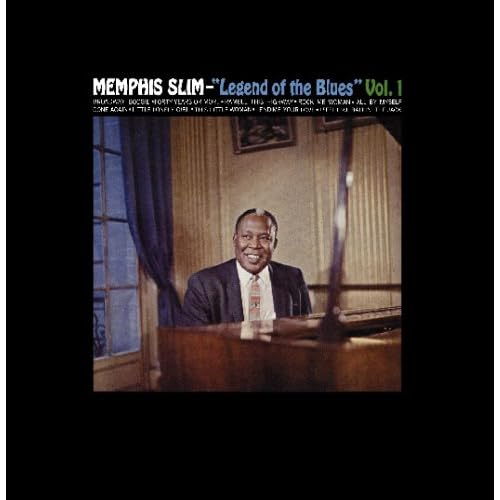
New Release Memphis Slim Legend of the Blues


Legend of the Blues
Memphis Slim Legend of the Blues
Click image for info @Amazon.com


I like Memphis Slim's music so much that I'm not sure that I can be objective. I have no problem calling him one of the greatest blues piano players of all time. And his singing is up there with the best blues vocalist too. I have to admit that I have never heard one of his CDs that I did not like. This one is no different. This album was issued on the Jubilee label in 1967 and is a very nice showing of Memphis Slims piano playing, this reissue is mastered from the original so it lives up to the first issue. And now we get it on CD.

Memphis Slim mp3s @Amazon.com
Memphis Slim @SueezeMyLemon
Memphis Slim @Hype Machine


Thursday, May 26, 2011

Pinetop Perkins -Piano

Wikipedia

Joseph William Perkins (July 7, 1913 – March 21, 2011), known by the stage name Pinetop Perkins, was an American blues musician, specializing in piano music. He played with some of the most influential blues and rock and roll performers in American history, and received numerous honors during his lifetime including the Grammy Lifetime Achievement Award, and induction into the Blues Hall of Fame.

BBC
"He is the blues, he is the epitome of it," Mr Southard said. "He lived it, breathed it."

Once asked about his longevity, Perkins said: "I always try to do something different all the time."

Another blues legend, BB King, said: "He was one of the last great Mississippi Bluesmen, and he sure could play the piano. He will be missed not only by me, but by lovers of music all over the world."


Friday, August 15, 2014

Charles Brown - Driftin' Blues (The Best Of) (Full Album)

I love going back and looking at the wonderful blues musicians of the past, man the gems that you can find. Consider one Charles Brown, a master bluesman in my mind.  While some others may be better known, few can say they were as good.

Mr. Brown had a big mellow tone, and his piano work was top notch.  This album shows how influential he was.  You can hear the evolution of the blues in some of the songs that were covered by others.

As always, love the music, support the music, buy the music. Driftin Blues: Best of


Notes from YouTube;

Extremely underrated Blues man and hard to find album. He's known for the songs "Black Night" and "Driftin' Blues" both on this record. 

1. Driftin' Blues 0:00
2. Homesick Blues 3:16
3. Get Yourself Another Fool 6:28
4. In The Evening When The Sun Goes Down 9:32
5. A Long Time 12:30
6. It's Nothing 16:05
7. Trouble Blues 18:57
8. My Baby's Gone 21:21
9. Black Night 24:23
10. I'll Always Be In Love With You 27:32
11. Seven Long Days 30:29
12. Hard Times 33:33
13. Evening Shadows 36:44
14. I Lost Everything 39:31
15. Lonesome Feeling 42:31
16. Cryin' Mercy 45:29
17. I've Been Saving My Love For You 48:13
18. Fool's Paradise 50:12
19. Please Don't Drive Me Away 53:00
20. Merry Christmas Baby 55:23


Wednesday, September 28, 2005

mp3s by Lonnie Johnson

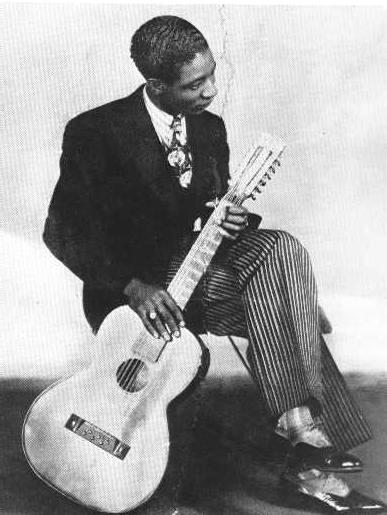
Lonnie_Johnson_1929


Born Alfonzo Johnson on February 8, 1894, Lonnie Johnson was one of the inventors of the blues and early jazz. He was born in New Orleans, Louisiana in a family of musicians. He played the blues on piano, violin, banjo and guitar. He is most well know for his guitar work.

He died in 1970 of complications from a car wreck that he was in a year earlier. In 1997 he was inducted into the Louisiana Blues Hall of Fame.

mp3s

"Mr. Johnson's Blues" - (2:43, 464 kB) - 9435-A-OK 8253, St. Louis, Mo., 4 November 1925

"Lonesome Jail Blues" - (3:08, 540 kB) - 73939-B-OK 8309, New York City, 19 January 1926

"Sam, You're Just a Rat" - (3:15, 558 kB) - 405141-A, 9 February 1932

"The Loveless Blues" - (3:11, 556 kB) - BS 044051, 2 November 1939

"Tomorrow Night" - (3:02, 524 kB) - Cincinnati, 10 December 1947

references

Wikipedia Article on Lonnie Johnson

Answers.com Article on Lonnie Johnson

Web page on Lonnie Johnson @ RedHotJazz.com - Includes a great man Real Player music files.

Blues Lyrics by Lonnie Johnson @ Blues Lyrics On Line

file under;
, ,


Saturday, November 14, 2009

Christmas Blues, Too Early?

Is it too early for Christmas Blues? I'll let you decide, but in the mean time and as Christmas rapidly approaches I've started to put together a list of songs over at Blip.fm.

As some of you may or may not know my Blip.fm page is >>> http://blip.fm/FitzgeraldKC


Marty Stuart – Even Santa Claus Gets the Blues

Lisa Layne – Blues for Christmas

Canned Heat – Christmas Blues

John Lee Hooker – Blues for Christmas

Eric Reed – Christmas Blues

Johnny Guarnieri – Santa's Secret - Humorous little jazz piano number about a Smoking Santa.

Dave McKenna – Don't Want No Blues This Christmas


Thursday, November 12, 2009

It's the Birthday of Bukka White

Today is the birthday of Bukka White. He was born November 12, 1909 and passed away February 26, 1977.

According to Wikipedia

Bukka White (November 12, 1909 -- February 26, 1977) was a delta blues guitarist and singer. "Bukka" was not a nickname, but a misspelling of White's Christian name by his second (1937) record label, (Vocalion).

Born Booker T. Washington White near Houston, Mississippi, he gave his cousin B. B. King, a Stella guitar, King's first guitar. White himself is remembered as a player of National Steel guitars. He also played, but was less adept at, the piano.
White started his career playing the fiddle at square dances. He claims to have met Charlie Patton early on, although some doubt has been cast upon this; regardless, Patton was a large influence on White. White typically played slide guitar, in an open tuning. He was one of the few, along with Skip James, to use a crossnote tuning in E minor, which he may have learned, as James did, from Henry Stuckey.

He first recorded for the Victor Records label in 1930. His recordings for Victor, like those of many other bluesmen, fluctuated between country blues and gospel numbers. His gospel songs were done in the style of Blind Willie Johnson, with a female singer accentuating the last phrase of each line.
Nine years later, while serving time, he recorded for folklorist John Lomax. The few songs he recorded around this time became his most well-known: "Shake 'Em On Down," and "Po' Boy."

Bob Dylan covered his song "Fixin' to Die Blues", which aided a "rediscovery" of White in 1963 by guitarist John Fahey and ED Denson, which propelled him onto the folk revival scene of the 1960s. White had recorded the song simply because his other songs had not particularly impressed the Victor record producer. It was a studio composition of which White had thought little until it re-emerged thirty years later. White was at one time managed by experienced Blues manager, Arne Brogger. Fahey and Denson found White easily enough: Fahey wrote a letter to "Bukka White (Old Blues Singer), c/o General Delivery, Aberdeen, Mississippi." Fahey had assumed, given White's song, "Aberdeen, Mississippi", that White still lived there, or nearby. The postcard was forwarded to Memphis, Tennessee, where White worked in tank factory. Fahey and Denson soon travelled to meet White, and White and Fahey remained friends throughout White's life.. He recorded a new album for Denson & Fahey's Takoma Records, whilst Denson became his manager.

White was, later in life, also friends with fellow musician, Furry Lewis. The two recorded, mostly in Lewis' Memphis apartment, an album together, Furry Lewis, Bukka White & Friends: Party! At Home.

One of his most famous songs, "Parchman Farm Blues", about the Mississippi's infamous Parchman Farm state prison, was to be released on Harry Smith's fourth, never realized, volume of the Anthology of American Folk Music. His 1937 version of the oft-recorded song, "Shake 'em on Down," is considered definitive, and became a hit while White was serving time in Parchman.

White was sampled by electronic artist Recoil for the track, "Electro Blues For Bukka White", on the 1992 album, Bloodline; the song was reworked and re-released on the 2000 EP "Jezebel".
Bukka White - Parchman Farm Blues


Bukka White @Amazon.com
Bukka White @SqueezeMyLemon


Wednesday, November 12, 2008

It's the Birthday of Bukka White

Today is the birthday of Bukka White. He was born November 12, 1909 and passed away February 26, 1977.

According to Wikipedia

Bukka White (November 12, 1909 -- February 26, 1977) was a delta blues guitarist and singer. "Bukka" was not a nickname, but a misspelling of White's Christian name by his second (1937) record label, (Vocalion).

Born Booker T. Washington White near Houston, Mississippi, he gave his cousin B. B. King, a Stella guitar, King's first guitar. White himself is remembered as a player of National Steel guitars. He also played, but was less adept at, the piano.
White started his career playing the fiddle at square dances. He claims to have met Charlie Patton early on, although some doubt has been cast upon this; regardless, Patton was a large influence on White. White typically played slide guitar, in an open tuning. He was one of the few, along with Skip James, to use a crossnote tuning in E minor, which he may have learned, as James did, from Henry Stuckey.

He first recorded for the Victor Records label in 1930. His recordings for Victor, like those of many other bluesmen, fluctuated between country blues and gospel numbers. His gospel songs were done in the style of Blind Willie Johnson, with a female singer accentuating the last phrase of each line.
Nine years later, while serving time, he recorded for folklorist John Lomax. The few songs he recorded around this time became his most well-known: "Shake 'Em On Down," and "Po' Boy."

Bob Dylan covered his song "Fixin' to Die Blues", which aided a "rediscovery" of White in 1963 by guitarist John Fahey and ED Denson, which propelled him onto the folk revival scene of the 1960s. White had recorded the song simply because his other songs had not particularly impressed the Victor record producer. It was a studio composition of which White had thought little until it re-emerged thirty years later. White was at one time managed by experienced Blues manager, Arne Brogger. Fahey and Denson found White easily enough: Fahey wrote a letter to "Bukka White (Old Blues Singer), c/o General Delivery, Aberdeen, Mississippi." Fahey had assumed, given White's song, "Aberdeen, Mississippi", that White still lived there, or nearby. The postcard was forwarded to Memphis, Tennessee, where White worked in tank factory. Fahey and Denson soon travelled to meet White, and White and Fahey remained friends throughout White's life.. He recorded a new album for Denson & Fahey's Takoma Records, whilst Denson became his manager.

White was, later in life, also friends with fellow musician, Furry Lewis. The two recorded, mostly in Lewis' Memphis apartment, an album together, Furry Lewis, Bukka White & Friends: Party! At Home.

One of his most famous songs, "Parchman Farm Blues", about the Mississippi's infamous Parchman Farm state prison, was to be released on Harry Smith's fourth, never realized, volume of the Anthology of American Folk Music. His 1937 version of the oft-recorded song, "Shake 'em on Down," is considered definitive, and became a hit while White was serving time in Parchman.

White was sampled by electronic artist Recoil for the track, "Electro Blues For Bukka White", on the 1992 album, Bloodline; the song was reworked and re-released on the 2000 EP "Jezebel".
Bukka White - Parchman Farm Blues


Bukka White @Amazon.com
Bukka White @SqueezeMyLemon


Tuesday, March 31, 2009

Humbled by the blues

Friends, I just want to let you all know that I am humbled by the blues. I love this music so much, and when I started this blog I thought I had a good understanding of it all. I thought that because I was raised in the blues, listen to the blues, read about the blues, played the blues and had lived the blues that I really understood it.

But there is just so much to know, so many great songs, so many great musicians. So much culture that is related to the blues. So much history, and it never stops it just keeps on going. This music is high art, and don't let anyone tell you anything different.

You could spend your whole life studying just guitar players, you could spend your whole life just studying guitar players from the state of Mississippi. You could spend your whole life just studying slide guitar players from the state of Mississippi. Not to mention, singers, harmonica players, drummers, piano players and many other kinds of musicians in all different kinds of combinations from just the state of Mississippi. And then you could do it all over again for the states of Texas, Louisiana, New York, California, South Carolina, Illinois, just put your favorite state, city or even country where Mississippi is above.

I'm humbled and still I wonder "how blue can you get baby."


Wednesday, January 06, 2016

Louisiana Blues - The Best Louisiana Sounds


Tracklist :

00:00 - Clarence Frogman Henry - I Ain't Got No Home

02:19 - Little Walter - My Babe

04:49 - Clarence Garlow - New Bon Ton Roulay

07:38 - Bobby Charles - Take It Easy Greasy

09:50 - Louisiana Red - Alabama Train

13:07 - Muddy Waters - Louisiana Blues

15:59 - Slim Harpo - I'm a King Bee

18:56 - Big Bill Broonzy - Southern Flood Blues

22:12 - Big Joe Reynolds - Third Street Woman Blues

24:52 - Little Walter - Come Back Baby

27:54 - Bobby Charles - See You Later Alligator

30:42 - Slim Harpo - I Got Love If You Want It

33:26 - Lightnin' Slim - It's Mighty Crazy

35:53 - Warren Storm - Mama Look What Your Liitle Boy's Done

38:12 - Lightnin' Slim - My Starter Won't Start

41:00 - Lazy Lester - I'm a Lover Not a fighter

43:42 - Little Walter - You'd Better Watch Yourself

46:45 - Muddy Waters & Little Walter - Forty Days and Forty Nights

49:50 - Louisiana Red - You're Gonna Need Me Baby

53:08 - Big Bill Broonzy - John Henry

56:26 - Big Bill Broonzy - Key to the Highway

59:27 - Guitar Slim - The Things That I Used to Do

01:02:25 - Smiley Lewis - I Hear You Knocking

01:04:56 - Al Ferrier - Hey Baby

01:07:19 - Big Bopper - Chantilly Lace

01:09:42 - Boozoo Davis - Paper In My Shoe

01:11:54 - Muddy Waters - Meanest Woman

01:14:11 – Hawketts - Mardi Gras Mambo

01:16:19 - Earl King - Those Lonely Lonely nights

01:18:43 - Huey Piano Smith - Rockin' New Pneumonia

01:20:55 - Cookie & The Cupcakes - Mathilda

01:24:06 - Lazy Lester - Sugar Coated Love

01:26:50 - Huey Piano Smith - Don't You Just Know It

01:29:17 - Rod Bernard - Pardon Mr. Gordon

01:31:22 - Lightnin' Slim - Rooster Blues

01:33:51 - Frankie Ford - Sea Cruise

01:36:33 - Rod Bernard - This Should Go On Forever

01:39:17 - John Fred - Shirley

01:41:08 - Al Terry - Watchdog

01:43:12 - Joe Jones - You Talk Too Much

01:45:43 - Slim Harpo - Rainin' In My Heart

01:48:14 - Big Boy Myles - New Orleans

01:50:34 - Charles Sheffield - It's Your Voodoo Working

01:52:17 - Clarence Frogman Henry - But I Do

01:54:34 - Jimmy Clanton - Just a Dream

01:57:03 - Warren Storm - Prisoner's Song