Thursday, August 10, 2006

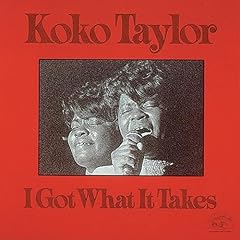
Great Blues Recordings - Koko Taylor, I Got What it Takes


In my continuing series of what I think of as the great blues recordings I want to present Koko Taylor's album "I Got What it Takes."

To say that I love this album is an understatement. It takes me back to a time in my boyhood that I became aware of the women who hung out at juke joints. The kind of woman who would make a statement like "I Got What it Takes" and mean it.

And if you listen to this album you will come away from it secure in the knowledge that Mrs. Taylor has what it takes too. The album was recorded in 1975, and this was just about around the time that I am talking about. This was Taylor's first release for Alligator Records and is a good introduction to her later work for that label. This CD contains 11 tracks which make for the kind of modern party music played in juke joints all over the blues world at the time, they all have that gritty but upbeat sound that I love to wallow in.

The liner notes to the release state, Koko Taylor has "no hesitation at all to put you right down in blues alley. There's total involvement, total commitment to the truth of the blues. Whether you want to or not — she'll make you get down." If you buy this CD and give it a listen, you will have no doubt about this.

Tracks from this CD

01. Trying To Make A Living <- Click here to sample this song.
02. I Got What It Takes
03. Mama, He Treats Your Daughter Mean
04. Voodoo Woman
05. Be What You Want To Be
06. Honkey Tonkey
07. Big Boss Man
08. Blues Never Die
09. Find A Fool
10. Happy Home
11. That's Why I'm Crying

I did a search for some cool Koko Taylor video, but could not find anything from this album. Please take a look at this video to get a sense of what it is like to see Mrs. Taylor perform in person.


Blues blog tags
file under;
, ,


Thursday, August 03, 2006

Thursday, July 20, 2006

Mississippi Fred McDowell - Goin Down to the River

Everybody seem to like the last Mississippi Fred McDowell video. So here is another, thanks to YouTube. And for all you guitar players out there, this note was also provided:

This is from a web page written by Brian Robertson - "Mississippi Fred McDowell used the D tuning on a fairly regular basis, and one of the advantages is that it allows the high string (D) to play melody or, more often, to play along with the singer, as in his classic, "You Got to Move"

BTW - 'open D' is D A D F# A D


file under;
, ,


Sunday, July 16, 2006

Champion Jack Dupree mp3

You know a bluesman that I have wanted write about for a while now is Champion Jack Dupree. He is one of my favorite musicians from my home state of Louisiana. Now I know it might seem like I say things like that about so many different musicians, but you have to understand that when you are from Louisiana, there is always a great musician hanging around just waiting to be loved. Not to mention the great Louisiana musicians from the past.

Like Louis Armstrong he was a student at the New Orleans Home for Colored Waifs, where he learned how to play the piano. He was born in July of the early 1900s (different sources give different dates) and he died January 21, 1992. He lived such a colorful life that to my mind not only did he live the blues but he lived many other colors as well. He was a master boogie woogie barrelhouse house piano player, but he also served in the United States Navy as a cook. He was captured during WWII and even served some time as a Japanese Prisoner of War. He got his nickname Champion Jack because after meeting Joe Lewis he went on to become a Golden Gloves Boxing Champion.

You can read all about Champion Jack Dupree@ wikipedia.

He once said,

"When you open up a piano, you see freedom. Nobody can play the white keys and don't play the black keys. You got to mix all these keys together to make harmony. And that's what the whole world needs: Harmony."

Champion Jack Dupree - Hometown New Orleans.mp3

I love during this recording when he ask rhetorically, "People say, what is barrelhouse piano playing anyway?" and then he proceeds to show you. Good stuff indeed.

file under;
, ,


Tuesday, July 11, 2006

Mississippi Fred McDowell - John Henry Video

Now if you were to be a guitar playing man (or woman for that matter), you would do your self a favor if you were to watch as much Mississippi Fred McDowell as you could get your hands on. That's right, watch the blues children, listen to the blues, and baby play the blues. Live the blues, like Mississippi Fred McDowell did.

As the man famously said, "I do not play no rock and roll."


You can read about Mississippi Fred McDowell @ wikipedia.


file under;
, ,


Saturday, July 08, 2006

Video of Leadbelly

I've posted some mp3s of Leadbelly in this blog but until now I have not posted any video of him. These songs probably fit more in the folk music catagory, but I like them all the same. I love folk music (I love all kinds of music), but I like the simple lyrics and the presentation of most folk performers. Kind of the same way that I love the simple presentation of the early blues music.

Leadbelly for example had a very rhythmic way of playing his guitar as he sang. And seeing him on video is a much more satisfying experience then just hearing him sing. With that in mind, please take a look at this video of Leadbelly doing several of his songs. Note how he seems to be dancing with his guitar as he sings.


file under;
, ,


Friday, July 07, 2006

Blues Instruments - The Guitar.

I've read in Gerard Herzhaft's Encyclopedia of The Blues and other places that the guitar, became popular and cheap just as the first bluesmen began to develop their sound. At the time among white rural musicians the banjo and the fiddle were just as important as the guitar if not more popular.

The guitar was more flexible and allowed for making blue notes and the creation of a true blues scale. Because the guitar was a cheap instrument and it could produce a wide range of effects it dominated the playing of the early black musicians. The early bluesmen, did not play the guitar the way it was played by classically trained musicians, just as they also played the harmonica in a different way then in classical music. Most black musicians were not trained in classical music at the time anyway.

The early bluesmen, such as Blind Blake and Blind Lemon Jefferson adapted fingerpicking, in which the melody is interwoven among the alternating bass notes and flatpicking, which helps to create the idea of a lead guitar. In flatpicking, the musician plays the melody line, note by note, with a pick. This allows the guitar to accompany a singer in a call and response technique which is familiar to almost every fan of the blues. Where the singer sings a line, and then the guitar repeats that line or vice versa.

It is reported that Lonnie Johnson probably invented this technique thus forever codifying the guitar's place in both blues and later rock and roll. The idea of flat picking lead to the electric guitar, which really allowed the bluesmen and women to express themselves. Thus you get guitars crying and displaying emotions as seen in the playing styles of musicians like B.B. King, T. Bone Walker and later Stevie Ray Vaughn.

To read more about the many blues guitarist check this out Blues Guitarists @ wikipedia.

A little guitar trivia; The guitar has come to be called many different colloquial names over time such as:

axe,
box,
guit-box,
guit-fiddle,
guit-box-fiddle,
guit-axe,
bread-box,
bread-winner,
bread-box-winner,
bread-box-fiddle.

This post is brought to you by ActoGuitar.com, a guitar learning community with free guitar video lessons.


Saturday, July 01, 2006

Otis Rush "I Can't Quit You Baby" Video

Here is a cool video of another one of my favorite bluesmen. A man who not only played the blues but lived the blues. Otis Rush's guitar style is what intrigues me the most about him. He plays a right handed guitar left handed, upside down without restringing it. I think this makes the sound of his guitar playing unique. He has a big old tone on almost every note. Then there is the voice, he has a very powerful tenor voice that is shown well here.

I like how Mr. Rush totally looks the part of a bluesman in this video, neat dress, black sunglasses, processed hair. And then there is the audience in this video, straight out of the sixties. Too cool.


"Weeeeeeeeeeeeeeeeeeeeeeeeeeeeeeeeeeeeeeeell!
I can't quit you baby, but I got to put you down for a while,
Well, you know I can't quit you baby, but I got to put you down for a while,
Yes, you messed up my happy home baby, you made me mistreat my only child."

Otis Rush DVDs


Mr. Rush suffered a stroke in 2004 and has since recovered and by all accounts is doing well.

file under;
, , ,


Thursday, June 29, 2006

Great Blues Recordings: Slim Harpo, The Best of Slim Harpo


Great Blues Recordings: Slim Harpo, The Best of Slim Harpo

I have been thinking about starting a new series where I list my favorite blues recordings. I thought it might be helpful to those blues music lovers who are not familiar with much of the prewar blues music.

My idea is that there is so much good prewar blues music out that it is difficult for someone who is new to the blues. I want help my readers know what the good stuff is.

Slim Harpo, The Best of Slim Harpo (Hip-O 40072)

Slim Harpo is another one of those musicians from my home state of Louisiana, and I think that has a great effect on his style of music. His real name was James Moore and he was from Lobdell, Louisiana. He was on of the most sucessful bluesmen of the late 1950s and early '60s. His music as dipicted on this CD is swamp blues, which is a laid back, heavy on the back beat, and totally dancable blues music.

Gathering 18 tracks from 1957 to 1965, The Best of Slim Harpo is a selection of Harpo's best known hits and some of his not as well known but memorable sides. The combination of good sound quality and a good selection of songs makes this a highely listenable and danceable CD. It is hard for me to listen to this swamp blues sound and not want to dance.

You can read about Slim Harpo @ Wikipedia.

The 18 tracks on this CD include;

1. Baby Scratch My Back
2. I Got Love If You Want It
3. "I'm a King Bee" <<< Click to hear a sample of this song.
4. My Little Queen Bee (Got a Brand New King)
5. Shake Your Hips
6. Te-Ni-Nee-Ni-Nu
7. Buzz Me Babe
8. Buzzin'
9. Rainin' in My Heart
10. Still Rainin' in My Heart
11. Late Last Night
12. Tip on in, Pt. 1
13. Bobby Sox Baby
14. Don't Start Crying Now
15. I Need Money (Keep Your Alibis)
16. Strange Love
17. Rock Me Baby
18. Blues Hangover


file under;
, ,


Sunday, June 25, 2006

B.B. King & Jeff Beck - Paying the Cost to be the Boss

Speaking of B.B. King, here is a video of Jeff Beck and B.B. doing Mr. King's classic blues song, "Paying the Cost to be the Boss."

My daughter tells me that I walk around singing this song too often. But hey, what can I say? I mean every now and then you have to explain to people how it is you got to be the boss. Right? Enjoy the video.


Jeff Beck with B.B. King - Paying The Cost to be the Boss

Kind of curious how this video was titled, "Jeff Beck with B.B. King" it should be "B.B. King with Jeff Beck" seeing that they are playing a song that Mr. King made popular, and B.B. does all the singing. Mr. Beck does deliver on the guitar solo, and I think his playing complements B. B.'s song very well. The end of this video is a cliff hanger. Over the years B.B. has done many duets with other noted musicians. I think this is a little more lively than the version on B. B.'s CD "Duces Wild" with the Rolling Stones.

Below are a couple of my favorite B.B. King duet CDs.

Songs and musicians on "Duces Wild."

1. If You Love Me with Van Morrison
2. The Thrill Is Gone with Tracy Chapman
3. Rock Me Baby with Eric Clapton
4. Please Send Me Someone To Love with Mick Hucknall
5. Baby I Love You with Bonnie Raitt
6. Ain't Nobody Home with D'Angelo
7. There Must Be A Better World Somewhere with Dr. John
8. Confessin' The Blues with Joe Cocker Marty Stuart
9. Paying The Cost To The Boss with the Rolling Stones
10. Dangerous Mood with Joe Cocker
11. Keep It Coming with Heavy D
12. Cryin' Won't Help You Babe with David Gilmour & Paul Carrack
13. Night Life with Willie Nelson


Some complain about this CD not being based in the blues enough, but I have to say that I like how some of the musicians that perform on this CD help B.B. to update his sound, and move the blues closer to music like R&B and even rap. I know it is a point of contention amongst some blues fans, but rap and R&B overlap with blues music too, just as rock and roll does.

Songs and musicians on "Blues Summit."

1. Playin' With My Friends duet with Robert Cray
2. Since I Met You, Baby duet with Katie Webster
3. I Pity The Fool duet with Buddy Guy
4. You Shook Me duet with John Lee Hooker
5. Something You Got duet with Koko Taylor
6. There's Something On Your Mind duet with Etta James
7. Little By Little duet with Lowell Fulson
8. Call It Stormy Monday duet with Albert Collins
9. You're The Boss duet with Ruth Brown
10. We're Gonna Make It duet with Irma Thomas
11. I Gotta Move Out Of This Neighborhood/Nobody Love - B.B. King & Orchestra
12. Everybody's Had The Blues duet with Louis Walker

This CD is a bit more rooted in the blues as can be seen from the performances of noted blues musicians such as Robert Cray, Buddy Guy, John Lee Hooker, Koko Taylor and Albert Collins.


file under;
, , ,