Chuck Berry in Concert - London 1972
Monday, October 25, 2010
Friday, January 08, 2010
Happy Birthday To Tampa Red
Another bluesman who celebrated his birthday in January is Tampa Red. He was born on January 8 in 1904 and passed away on March 19, 1981.

Tampa Red - Don't Tampa with the Blues Photographic Print
Buy at AllPosters.com
You can read about the interesting life of Tampa Red by visiting the following links;
"Tampa Red" Whittaker (1904-1981)
Tampa Red's full bio @ Wikipedia
Click below to listen to sample Tampa Red mp3s
Thursday, May 28, 2009
It's the Birthday of T-Bone Walker
T-Bone Walker was born on May 28, 1910 and he passed away due to a stroke on March 15, 1975. He was an American blues guitarist, singer, pianist and songwriter who according to Wikipedia;
was one of the most important pioneers of the electric guitar. His electric guitar solos were among the first heard on modern blues recordings and helped set a standard that is still followed. He was ranked #47 in Rolling Stone Magazine's list of The 100 Greatest Guitarists of All Time.
I call that one the Gods of Guitar.
File under;
blues music T-Bone Video
Wednesday, January 14, 2009
Happy Birthday To Tampa Red
Another bluesman who celebrated his birthday in January is Tampa Red. He was born on January 8 in 1904 and passed away on March 19, 1981.

Tampa Red - Don't Tampa with the Blues Photographic Print
Buy at AllPosters.com
You can read about the interesting life of Tampa Red by visiting the following links;
"Tampa Red" Whittaker (1904-1981)
Tampa Red's full bio @ Wikipedia
Click below to listen to sample Tampa Red mp3s
Monday, July 07, 2008
A bluesman you probably don't know: Hip Linkchain
Tragedy is part and parcel of the blues, of life and everything really. And I have said it many times, you have to live the blues to play the blues, consider one Hip Linkchain.
Cancer took, the guitarist and song writer, Hip Linkchain's life before he got to be big on the blues scene, that is why I say "you probably don't know" him. His best album Airbusters was released before he passed away in 1989. It might have made all the difference, and brought him fame and fortune. But that was not to be.
He was born in Mississippi, like many other bluesmen, named Willie Richard at birth, he got his odd stage name because the white residents of the area called his seven-foot-tall dad, Linkchain. His dad got that name because he wore logging chains around his neck. The son was called "Hipstick" which led to Hip Linkchain. He learned to play the blues from his father and brother. During his time in the Delta he got to hear Elmore James, Little Milton, and Sonny Boy Williamson before he made that migration up to Chicago in the early 1950s.
During the 1950s and 1960s he played with harpists Dusty Brown, Willie Foster, and Lester Davenport, trying to make a name for himself in Chicago. In 1959 he played with Tyrone Davis in a band called the Chicago Twisters. Around 1981 he debuted with his album Change My Blues.

Airbusters
Like many bluesmen, Hip Linkchain never got the recognition that his talents would have brought him if he had lived. But I think that we blues fans of today can do much to keep his memory alive.
Monday, February 18, 2008
Memphis Minnie - Videos and mp3s
Yesterday I posted a Memphis Minnie video clip and it dawned on me that I have not posted anything about her, or any other of my favorite female blues musicians, in a while. A couple of years to be exact, in the case of Memphis Minnie.
Well I thought, I better do something about that.

Click here for Memphis Minnie @ Amazon.com
The below videos are so cool I almost don't have words to tell you how delightful they are. First they were placed on YouTube by Dan Chlipala. They are the marriage of Memphis Minnie's music and vintage photos that fit so well with the music. I think Dan has done a great job on these. Please take a look at them and visit his YouTube Blog via the link above, where you will find many more cool videos.
Keep On Eatin
Down In The Alley
Have You See My Rooster
Mp3s for your listening pleasure;
Kansas Joe & Memphis Minnie - "When the Levee Breaks" mp3
"Where is My Good Man At" mp3
Trail of The HellHound Bio for Memphis Minnie
Listen to a sample of "Bumble Bee Blues" (1.78MB wav)
Listen to a sample of "Soo Cow Soo" (2.01MB wav)
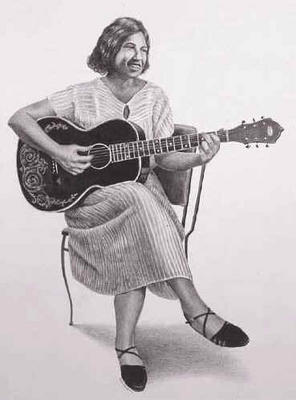
Guys like a girl who can play a guitar, and by all accounts Memphis Minnie could play it as well if not better then many of the men on the blues scene of her day. Take a listen to her music and read up on her history to get a picture of this blues great who played an important roll in shaping the music that we listen today.
Just the fact that she wrote and played "When The Levee Breaks", a 1929 Memphis Minnie and Kansas Joe song, was later covered by Led Zeppelin and released in 1971 on Zeppelin's fourth album, is enough for those of us who love music to sing her praises.
You can read about her here;
The forgotten queen - Was Memphis Minnie the mother of electric blues guitarists? by JoBeth Briton @ The Worcester Phoenix.
Memphis Minnie@Wikipedia

Click here for Memphis Minnie @ Amazon.com
file under;
Memphis
blues
music
mp3
Wednesday, January 16, 2008
Hubert Sumline Videos: The man in his own words.
I've been meaning to post these forever. I could write a few words about this, but as you know I like to let the bluesmen speak for themselves. Enjoy!
Notes from Youtube: Blues legend Hubert Sumlin talks about his punishment as a child for getting into some devilment with his father. He reminisces about Howlin' Wolf, Robert Johnson, Robert Jr. Lockwood and Charley Patton and he gives "Seventh Hour Blues" editor, Anthony Sapienza, a guitar lesson. Featuring "Smokestack Lightnin'" and "Killing Floor". Filmed by Anthony Sapienza.
Interview #2 in the series w/ blues legend Hubert Sumlin for Guitar Center's King Of The Blues '07.
Interview #3 in the series w/ blues legend Hubert Sumlin for Guitar Center's King Of The Blues '07.
Friday, July 07, 2006
Blues Instruments - The Guitar.
I've read in Gerard Herzhaft's Encyclopedia of The Blues and other places that the guitar, became popular and cheap just as the first bluesmen began to develop their sound. At the time among white rural musicians the banjo and the fiddle were just as important as the guitar if not more popular.
The guitar was more flexible and allowed for making blue notes and the creation of a true blues scale. Because the guitar was a cheap instrument and it could produce a wide range of effects it dominated the playing of the early black musicians. The early bluesmen, did not play the guitar the way it was played by classically trained musicians, just as they also played the harmonica in a different way then in classical music. Most black musicians were not trained in classical music at the time anyway.
The early bluesmen, such as Blind Blake and Blind Lemon Jefferson adapted fingerpicking, in which the melody is interwoven among the alternating bass notes and flatpicking, which helps to create the idea of a lead guitar. In flatpicking, the musician plays the melody line, note by note, with a pick. This allows the guitar to accompany a singer in a call and response technique which is familiar to almost every fan of the blues. Where the singer sings a line, and then the guitar repeats that line or vice versa.
It is reported that Lonnie Johnson probably invented this technique thus forever codifying the guitar's place in both blues and later rock and roll. The idea of flat picking lead to the electric guitar, which really allowed the bluesmen and women to express themselves. Thus you get guitars crying and displaying emotions as seen in the playing styles of musicians like B.B. King, T. Bone Walker and later Stevie Ray Vaughn.
To read more about the many blues guitarist check this out Blues Guitarists @ wikipedia.
A little guitar trivia; The guitar has come to be called many different colloquial names over time such as:
axe,
box,
guit-box,
guit-fiddle,
guit-box-fiddle,
guit-axe,
bread-box,
bread-winner,
bread-box-winner,
bread-box-fiddle.