The Wikipedia entry shows how important to Chicago Blues these guys were. Arguably the two brothers were prototypical cigar-chomping old-fashioned record men who took a chance on music they didn't really understand. (They were Jewish immigrants from Poland)
Powerhouse Of Blues (A Wagner Brothers Production) from Wagner Brothers on Vimeo.
Showing posts with label Chess Records. Show all posts
Showing posts with label Chess Records. Show all posts
Saturday, November 06, 2010
Leonard & Phil Chess


Saturday, December 06, 2008
NPR Reports on Chess Records Movies
I heard an interesting report by NPR's Neda Ulaby, which I thought you all would enjoy listening to and or reading. The radio report titled A Hollywood Makeover For Chess Records brings up details about the recent movies about Chess Records, Cadillac Records and Who Do You Love.
A couple of the points that I found most interesting was how both movies take some liberties with the facts. One question I had was did Lenored Chess really fool around with some of his female musicians? And what happened to Phil Chess in these movies?
I found the following quote by Leonard Chess' son, Marshall, to be very interesting;
He says the family's history is distorted in both films. Marshall Chess more or less grew up at Chess Records and worked there before the label was sold in 1969. He went on to become managing director of Rolling Stones Records. He's most upset that the bigger movie, Cadillac Records, cut out his uncle Phil entirely.Later in the report he says;
"That's horrible," Chess says. "It's like you make a movie about flight with the Wright brothers and you cut out one brother."
He says he's also irked by subplots suggesting that his father committed adultery — pure fiction, he insists. And he defends Chess Records' reputation for giving out cars instead of royalties — which is suggested in the title, Cadillac Records.
"Yes, we helped our artists who wanted to get Cadillacs get them," Chess says. "You have to understand, in that era, our artists did not have bank accounts (or) credit lines. So if they wanted a Cadillac bad enough and they pestered Phil and my father, we would set them up."
"My father evolved," Chess says, "from an immigrant to a bar owner in the ghetto to wanting to make money — seeing black people make the first real money of their lives [and] wanting to get a piece of it — to falling in love with the music."The report mentions Spinning Blues into Gold which is pictured below. I think it is a book that gives a more accurate history of Chess Records and the complicated legacy of the Chess brothers.
He says his father would be pleased that the movie Cadillac Records will introduce the Chess catalog to a new generation. And, of course, he says he would be thrilled about the royalties.
The Chess Brothers and the Legendary Chess Records
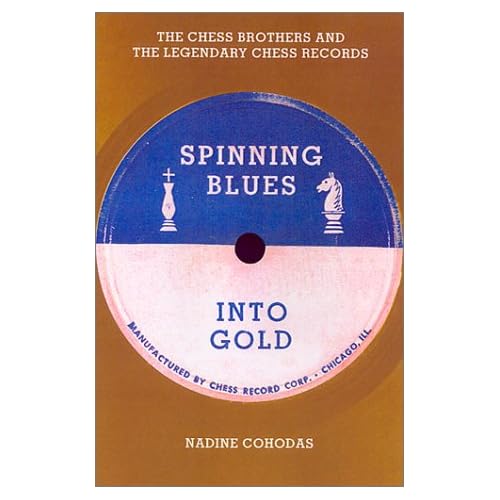
click image for info @Amazon.com

blues movies @SqueezeMyLemon
Saturday, April 08, 2006
Chess Records
Lately Chess Records has been on my mind. I have been listening to a lot of the music of the artist of Chess. If you don't know, Chess Records was an American record label, based in Chicago, Illinois. The brothers Leonard Chess and Phil Chess were the owners and operators of the company. Chess Records is one of the most important record labels in blues history and rock and roll too. If it were not for Chess Records we would not have some of the recordings that are considered the foundations of blues and rock and roll. They released many singles and albums by Muddy Waters, Howlin' Wolf, Sonny Boy Williams II (Rice Miller), Chuck Berry, Bo Diddley and many others.
While they had rock and roll, and rhythm & blues recording, the blues was their mainstay and the area where they had the biggest impact. People like Willie Dixon, Little Walter, John Lee Hooker, and Jimmy Reed among others worked with the Chess Brothers.
With Willie Dixon, an artist whose talent as a producer/songwriter/ session player during the 1950s and 1960s vastly contributed to the label's long-term success. Dixon was very instrumental and a vital figure at Chess Records. He was not only a good musician filling in as bassist and prolific songwriter. He aided in orchestration and was something of a figurehead for the label. But in my mind it is his songwriting that made him that man at Chess. Songs written by Dixon include "Back Door Man," "The Red Rooster," "Spoonful," and "I'm Your Hoochie Coochie Man." These are just a few of the songs that helped to make Chess Records the great label that it was.
Here are a few books that you might want to read about Chess Records;
The Record Men : Chess Records and the Birth of Rock & Roll (Paperback)
Spinning Blues into Gold : The Chess Brothers and the Legendary Chess Records (Paperback)
The Story of Chess Records (Hardcover)
file under;
music, blues, Chess Records, Willie Dixon

Subscribe to:
Posts (Atom)